Spatial Infrastructure for Physical AI: The PLAYC IP Stack

Walker Thisted
Co-Founder and CEO
August, 2026
I. A Broken Bridge
Everyone wants their habitat to function for them. We want a safe place to rest our head at night, a comfortable space to gather with family and friends, and thoughtful, seamless service when we step out into the world—whether dining at a neighborhood restaurant, staying at a hotel, or spending time at a private club.
The businesses and people who steward these physical habitats want them to function seamlessly, too. Achieving this was once an analogue pursuit. But as scale and complexity grew, a digital layer was inserted between legacy businesses and their guests. While digital platforms expanded discovery, they also drove a wedge between the digital and physical worlds. The attention economy created an incentive to keep people locked behind screens, resulting in fragmented software, manual point-of-sale friction, and a gradual erosion of trust between consumers and enterprises.
While inserting a digital layer between legacy businesses expanded what we can discover, it has failed to make our day-to-day environments run smoothly. Instead, the attention economy drove a wedge between the digital and physical worlds, prioritizing screen time over real-world experience. Beyond the consumer sphere, both staff and operators have become overwhelmed by app fatigue, administrative bloat, and intrusive surveillance tools deployed in the name of efficiency.
An erosion of trust has followed the unfulfilled promises of digital technology across every dimension of daily life—living, working, health, romance, and leisure. This disillusionment arrives precisely as decades of innovation and data aggregation converge into the most significant technical breakthrough in generations: large language models trained on massive neural networks. The resulting backlash manifests in mounting friction over copyright and data sovereignty, resistance to data center expansion, fears of widespread job displacement, and existential dread surrounding AGI.
While some concerns are justified, this backlash threatens the true potential of technology to solve the critical challenge of sustaining functional human habitats. To address consumer fatigue, deliver genuine ROI to physical businesses, and protect legacy platforms from AI disintermediation, artificial intelligence must be deployed to make physical spaces intelligent. Simultaneously, the legacy software that historically powered these spaces must integrate natively with this intelligence. Above all, individual consumers must be empowered with absolute data sovereignty and trust—guaranteeing they are not the product, but the ones actively dictating how their goals and preferences are fulfilled across the physical world.
To achieve this vision, we must build the connective tissue between artificial intelligence—its frontier LLMs, agentic interfaces, and portable preference graphs—and legacy software platforms. Crucially, this infrastructure must operate directly in the physical world we occupy, rather than remaining locked behind glass or isolated in the cloud. Achieving this demands an open approach grounded in interoperability over incumbent silos. On one hand, we need seamless spatial APIs that connect legacy platforms to physical space without burdening venues with the high cost of adopting yet another system. On the other, we must partner with frontier AI labs, establishing the native physical tool definitions their models need to translate intent into action. Above all, it requires a powerful orchestration engine that genuinely improves how our physical habitats function for all stakeholders.
II. A New Way to Read the Room: The PLAYC Protocol Stack
When we speak of building a "connective tissue," we describe an invisible infrastructure layer—an IP stack engineered to aggregate, structure, translate, and orchestrate data across physical and digital realms. Building this bridge begins by examining how consumers map intent alongside the growing backlash against invasive surveillance, location tracking, and purchase logging harvested for ad targeting. Today, almost no one actively owns or curates their personal preferences in a unified, structured manner. Personal context lacks physical agency: sharing goals or tastes with an AI agent leaves that data trapped inside an isolated chat log, with no native mechanism to reach the physical world or alter our immediate environment. Reconnecting digital intent to real-world experience requires first resolving this core trust deficit.
On the other side of the equation sits the enterprise responsible for fulfilling that intent. To achieve adoption, spatial infrastructure must enhance rather than replace existing venue software, recognizing that forcing platform overhauls only delays spatial intelligence. By integrating natively with legacy enterprise systems, the architecture unlocks true interoperability—allowing guests to carry their Portable Preference Graph across property boundaries while enabling venues to coordinate service seamlessly. In doing so, this abstraction layer becomes far more than another software application; it serves as foundational infrastructure for the spatial web.
In the middle lies physical space itself—a dynamic analog environment filled with fluctuating light, temperatures, acoustic moods, circulation flows, points of entry and egress, occupancy limits, furniture, artwork, and active service elements. Bringing a room to life requires coordinating staff, guests, and physical assets in real time, yet mapping this physical reality presents formidable spatial challenges. Physical footprints are defined by structural substrates, heavy masonry, reflective glass, and constantly moving human bodies that cause radio-frequency signal attenuation, multipath interference, and line-of-sight occlusions.
To map spatial utilization accurately within these dynamic environments, edge sensing infrastructure cannot rely on crude macro-signals or invasive surveillance cameras. Instead, low-power PLAYC Anchors must be strategically situated across active footprint zones—surface-mounted via conservation-grade polymer buffers or integrated directly into architectural fixtures. Operating as a synchronized edge mesh, these anchors utilize multi-node Phase-Based Ranging (PBR) wave physics to overcome RF occlusion, continuously capturing sub-meter spatial coordinates and environmental parameters without harvesting persistent personal identifiers or compromising architectural integrity.
Synthesizing these reflections, we can focus our primary challenge across three core requirements: 1) aggregating and structuring human preference and intent within physical environments, 2) tracking spatial utilization and real-time intent fulfillment, and 3) translating spatial interaction points directly into legacy enterprise software, goods, and services. Crucially, the underlying architecture must enforce strict data sovereignty—ensuring information remains encrypted, anonymized, and shared exclusively through explicit zero-knowledge authorization. Ultimately, this framework must support the entire spectrum of human engagement, functioning as seamlessly for a founding member with a deeply curated profile as it does for an anonymous first-time guest entering a venue on a whim.
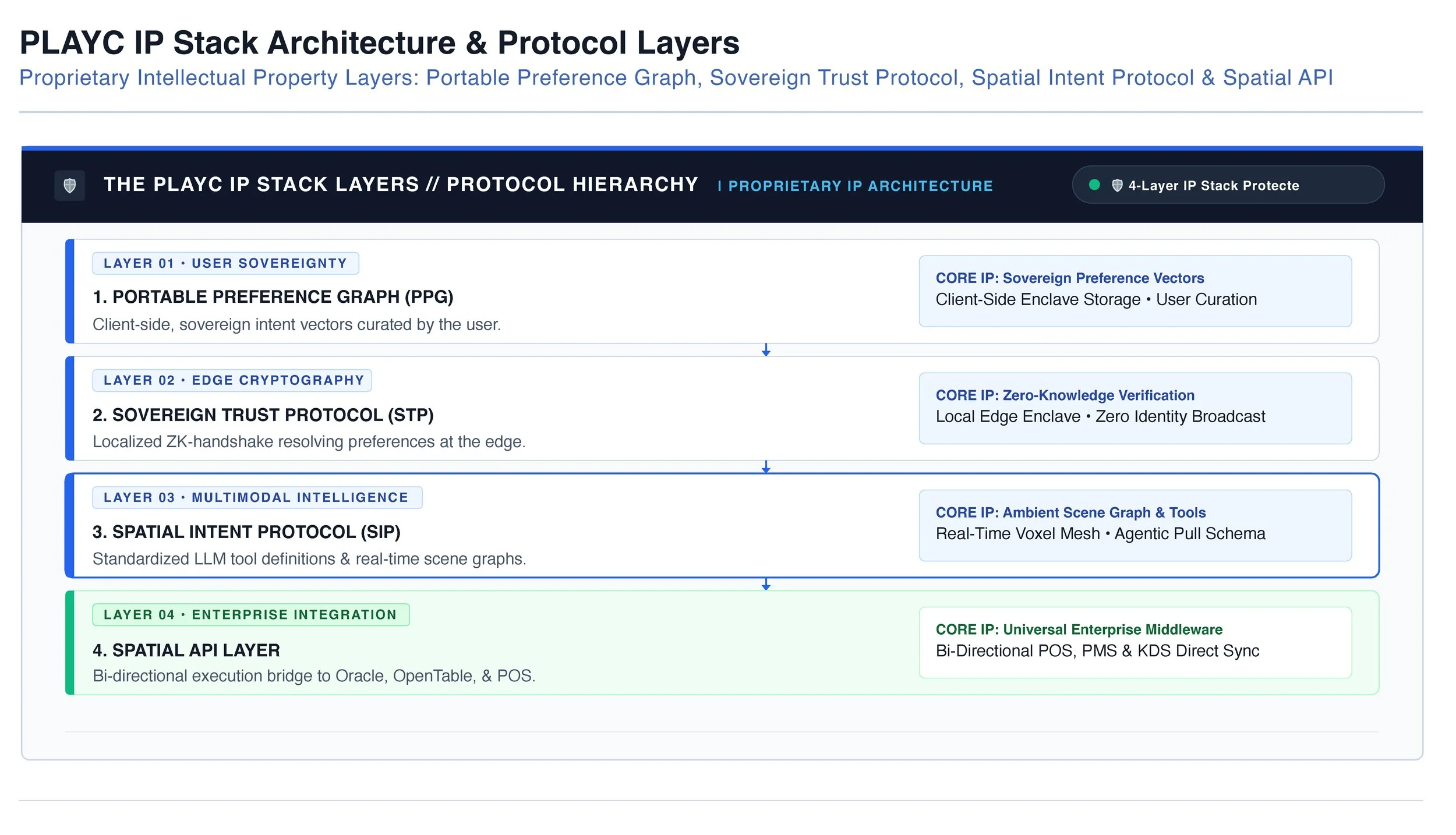
The Architecture of the PLAYC Stack
1. Portable Preference Graphs (PPG)
To give personal context real-world agency, we begin by structuring Portable Preference Graphs (White Paper #2). At an implicit level, these graphs capture anonymous behavioral patterns within a space—building a gradual understanding of how needs are expressed, supported, and fulfilled over time. At an explicit level, they represent a curated collection of goals, dietary bounds, and lifestyle tastes that an individual actively develops in conversation with their chosen AI agent, whether ChatGPT, Claude, or Gemini. Structured to bridge digital intent with physical execution, these preference graphs allow an individual's tastes to directly influence their environment and follow them seamlessly from one venue to the next.
2. The Sovereign Trust Protocol (STP)
Once constructed, these portable preferences must be safely carried into physical space. When an individual enters a venue, ambient infrastructure—such as existing Wi-Fi routers or edge-deployed PLAYC Anchors—registers their presence. Guests without an active profile remain completely anonymous, contributing solely to generalized spatial utilization maps. For profile holders, a localized, zero-knowledge cryptographic handshake is executed between their mobile device and the local Anchor via the Sovereign Trust Protocol (White Paper #3). This ephemeral handshake verifies presence and temporarily unlocks relevant preference sub-graphs for that specific location. Personal data remains cryptographically isolated at the edge, ensuring zero cloud exposure and complete anonymization the moment the guest departs.
3. The Spatial Intent Protocol (SIP)
Inside the venue, environmental sensors, lighting controls, room scans, and Anchors (White Paper #5) operate in concert to map how physical space is used and how staff fulfill guest needs. The Spatial Intent Protocol (White Paper #4) aggregates this multi-modal telemetry and translates physical spatial dynamics into standardized tool definitions for LLMs. Rather than treating AI as a passive chat interface, SIP provides frontier models with the structured schemas required to read room states, evaluate real-time intent, and dynamically generate tailored orchestration paths for guests and floor staff alike. This enables high-touch service and contextual offerings to be delivered naturally in the physical world, rather than pushed through intrusive digital advertisements.
4. The Spatial API & Enterprise Orchestration
To complete the circuit, the Spatial API (White Paper #6) acts as a bi-directional execution bridge between SIP’s spatial intelligence and legacy enterprise software stacks. It enables real-world state changes—such as a guest sitting in a specific dining zone—to trigger actions across existing Point-of-Sale (POS), Property Management (PMS), and reservation systems like Oracle or OpenTable. Conversely, updates within those legacy platforms can instantly adjust ambient floor conditions or guide staff workflows. By allowing existing software to interface natively with physical space, the Spatial API keeps the PLAYC infrastructure layer completely invisible. Whether accessed behind the scenes or through an optional standalone PLAYC app, preferences remain portable, data remains sovereign, and a new way to read the room is realized.
III. More Than an IP Stack, A Vision for the Future
The promise of this next technological paradigm is an ambient, intelligent experience—a system of seamless service orchestration rooted firmly in the physical economy. At its core lies total trust, built on an architecture that shields sensitive personal and enterprise data behind strict cryptographic boundaries, unlocked exclusively through physical presence and explicit user consent. This infrastructure acts as a translation layer, converting human intent into real-time physical execution.
It takes physical shape through dedicated edge hardware, agentic software interfaces, and a robust enterprise backbone. By organizing telemetry strictly around intent vectors rather than invasive surveillance, the platform continually refines its orchestration capabilities. In doing so, it creates a secure network of spatial interaction points into which legacy software and physical service providers can plug. This strips away point-of-sale friction and administrative overhead, giving rise to contextual services delivered seamlessly at specific moments in space and time.
Rather than operating as isolated technical specifications, the components of the PLAYC stack synthesize into a singular human experience. To guide this operational synthesis, our architecture is anchored in four core tenets:
1. Sovereign Intent
An individual’s desires, goals, and physical presence belong strictly to them. Instead of harvesting data for third-party ad networks, technology must act as a neutral steward—ensuring guests retain absolute ownership over their preference graphs while engaging with physical spaces strictly on their own terms.
2. Building With Integrity
True alignment between software and humanity must be screenless, invisible, and instantaneous. By moving intent fulfillment out from behind glass and orchestrating complex logistics behind an invisible trust layer, we eliminate cognitive fragmentation and digital anxiety—restoring a profound sense of physical presence.
3. The Unbiased Matchmaker
Direct, uncorrupted alignment between guest and enterprise represents the highest form of hospitality. By stripping away ad auctions, middleman data brokers, and algorithmic distortion, the orchestration engine facilitates pure, high-congruence interactions built on mutual respect and institutional trust.
4. Ephemeral Presence, Persistent Personal Memory
Physical presence should never be converted into persistent cloud surveillance. The moment an intent is fulfilled and a guest departs, the spatial handshake dissolves and local edge hardware undergoes immediate zero-fill eviction. Personal memory belongs to the individual, leaving the venue with zero identifying trace of a visit while preserving the guest's private graph as a self-sovereign record. Simultaneously, fully anonymized, non-identifiable telemetry persists within the platform layer—continuously training localized models to refine service orchestration, optimize venue operations, and elevate future experiences without compromising individual privacy.
This is the orchestration engine in action—the lived phenomenon of physical AI operating seamlessly in real time. Rather than making technology feel calculated, intrusive, or sterile, the environment itself becomes an intuitive partner. As an intent vector intersects verified spatial coordinates, the engine translates spatial wave physics and self-sovereign context into subtle, low-glance ambient cues. Floor staff receive gentle micro-haptic pulses or whisper-quiet earpiece notes that inform their next move without pulling their focus to a screen—enabling fluid, hyper-personalized hospitality that preserves unbroken eye contact and genuine human connection, a paradigm detailed in White Paper #7: Ambient Intelligence and Guidance.
IV. Value Creation & Economic Alignment
Aligning products and services directly with physical spaces creates an opportunity far deeper than basic digital connectivity. By tailoring offerings to real-world context, physical goods and services deliver lasting, predictive utility. This unlocks a double sustainability: establishing economic predictability for enterprises while eliminating physical waste and logistical inefficiency.
The result is a streamlined relationship between enterprises and their communities. By eliminating the immense capital wasted on intrusive ad auctions, click-tracking, and speculative marketing, enterprises can redirect resources toward crafting higher-quality physical products and delivering memorable service experiences. In turn, this economic shift fosters genuine loyalty—driving adoption as consumers demand absolute privacy, data trust, and intelligent spatial coordination.
Redirecting focus toward real-world environments reflects a growing consensus: flat glass screens have become a cognitive distraction, and individuals increasingly seek genuine physical presence. At the same time, the next paradigm shift in artificial intelligence will not emerge from 2D web interfaces, but from multimodal data deeply rooted in physical geometry and real-world behavior. Moving beyond the screen requires synthesizing a powerful convergence of technologies—zero-trust cryptography, low-power edge silicon, robotics, spatial world models, and decentralized networks.
Deploying this technical synthesis to resolve daily operational friction establishes native interoperability between fragmented venue software, enterprise platforms, client devices, and frontier AI models. Crucially, this architecture generates an invaluable, privacy-sanitized dataset that can be exchanged directly for AI compute—establishing a mutually aligned economic model to replace the extractive attention economy. This value exchange is both highly lucrative and structurally justified by the immense operational efficiencies, heightened venue yield, and frictionless human experiences it unlocks across physical space.
V. Governance & Structural Guardrails
The PLAYC Trust Protocol functions as an explicit covenant with our community. It translates our technical architecture into a promise to the individuals who occupy physical spaces, the enterprises that steward them, and the developers who extend this ecosystem—a pledge rooted in transparency, collaboration, and mutual benefit. We aim to restore faith in technology by fulfilling software’s original promise of human liberation: realigning technological assets to serve real-world human experience rather than harvesting human attention.
To steward a protocol of this scale while remaining aligned with our founding principles, we govern our development through five structural guardrails:
Relentless Focus on Operational Utility: We prioritize real-world functional value and floor-level problem solving over speculative technical trends or engagement-maximization loops.
Decentralized Network Ownership: Through our edge hardware architecture, venues co-own the physical network layer. PLAYC serves as the neutral administrator, innovator, and steward of the protocol, rather than an extractive gatekeeper.
Capital-Efficient Architecture: We maintain extreme capital discipline by avoiding foundation model pre-training traps. Instead, we interface with frontier models via zero-data-retention pipelines and offset compute costs by trading anonymized spatial telemetry for platform credits.
Direct Economic Redistribution: We return value to the ecosystem by eliminating the price inflation caused by digital ad spend, providing physical venues with new, high-margin revenue streams.
Value Capture at the Physical Boundary: Positioning our infrastructure at the exact boundary where digital intent meets physical execution allows significant economic activity to flow across our stack. This unlocks sustainable SaaS revenue and investor returns through pure transaction volume and operational efficiency.
The transition from invasive surveillance capitalism to ambient, sovereign orchestration cannot be accomplished in isolation. It requires an alliance of venue stewards, enterprise architects, and individuals committed to reclaiming human agency. We invite you to step beyond the screen, align with the trust protocol, and help build the physical infrastructure that brings intelligence back into harmony with human reality.